

Drawings and documents
National Archives restored drawings: drawing
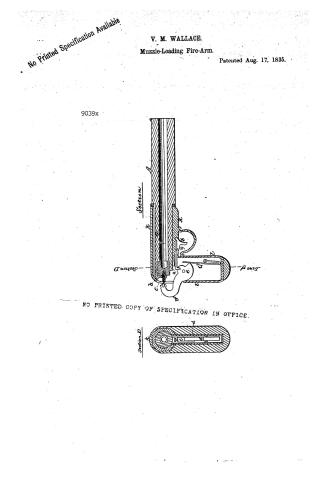
V.M. Wallace's Patent Drawing for a Pocket Pistol

National Archives, Restored Patent Drawings (Record Group 241) · Full-size scan at the National Archives · Catalog record
Show the text on the drawing Hide (91 words)
Words on the drawing as machine-read by the National Archives; not checked. Useful mainly for searching.
of FARE-ARMS. / CLASSIFICATION / Locks. / 9039 x / DIVISION. / V. VII WALLACE / Packel Ristel / Patenled 17 thcarg 1835 / A. Barrel. a Roundporterng / b. Brench pin / C. Ninple / cl. Main spring / e. Dog of cock / f Cock / I Extension of Tregger / h Small actingon? / : Trigger / K. Case 07' covering of Wood / l. France of Melal / Section B / Sections / C. P / Patent office Hunc 28th 1842 / Mach under the direction of the comminious / of Patenb in of is March 183 / Strickland Del / Communicar of Patents
USPTO scan
The patent as scanned by the USPTO
-
 Page 1
-
 Page 2
-
 Page 3
-
 Page 4
-
 Page 5


U.S. Patent and Trademark Office · Google Patents
Show the transcription Hide (1,453 words)
Machine transcription (LightOnOCR) of the pages as scanned by the USPTO, most of them the handwritten copies made when the records were restored after the 1836 fire. Not checked; it can misread handwriting, so compare it with the scan.
Page 1.
No Printed Specification Available
V. M. WALLACE.
Muzzle-Loading Fire-Arm.
Patented Aug. 17, 1835.
9039x

NO PRINTED COPY OF SPECIFICATION IN OFFICE.

Page 2.
Aug. 17, 1835
Victor M. Wallace
Letters Patent
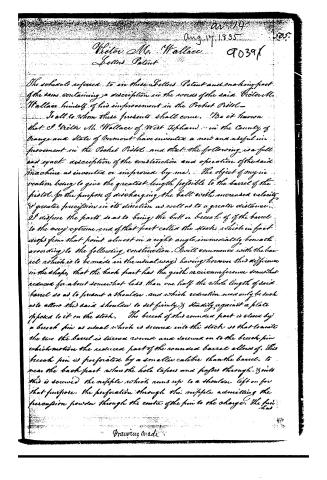
The schedule referred to in these Letters Patent and making part of the same containing a description in the words of the said Victor M. Wallace himself of his improvement in the Pocket Pistol—
To all to whom these presents shall come. Be it known that I, Victor M. Wallace of West Topham in the County of Orange and State of Vermont have invented a new and useful improvement in the Pocket Pistol and that the following is a full and exact description of the construction and operation of the said machine as invented or improved by me. The object of my invention being to give the greatest length possible to the barrel of the pistol for the purpose of discharging the ball with increased velocity & greater precision in its direction as well as to a greater distance. I dispose the parts so as to bring the butt or breech of the barrel to the very extreme end of that part called the stock which in fact drops from that point almost in a right angle immediately beneath according to the following construction. I will commence with the barrel which is to be made in the usual way, having however this difference in the shape, that the back part has the girth or circumference somewhat reduced for about somewhat less than one half the whole length of said barrel so as to present a shoulder, and which reduction need only be such as to allow this said shoulder to set firmly & steadily against a plate of wood to it on the stock. The breech of this rounded part is closed by a breech pin as usual which is secured into the stock so that to unite the two the barrel is turned round and screwed on to the breech pin which motion the reduced part of the rounded barrel allows of. This breech pin is perforated by a smaller caliber than the barrel, to near the back part where the hole tapers and passes through. Into this is screwed the nipple which runs up to a shoulder left on for that purpose, the perforation through the nipple admitting the percussion powder through the centre of the pin to the charge. The pin has
Drawing made.
Page 3.
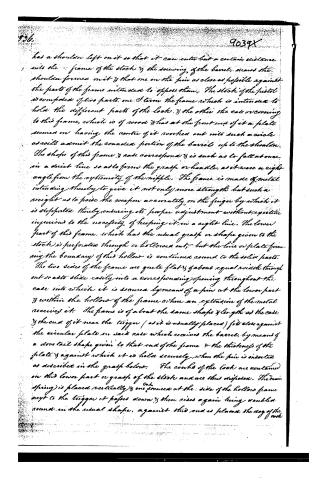
has a shoulder left on it so that it can enter but a certain distance into the frame of the stock & the screwing of the barrel, draws the shoulder formed on it & that one on the pin as close as possible against the parts of the frame intended to oppose them. The stock of the pistol is composed of two parts, one I term the frame which is intended to hold the different parts of the lock, & the other the case covering to this frame, which is of wood & has at the front end of it a plate secured on having the centre of it worked out into such a circle as will admit the rounded portion of the barrel up to the shoulder. The shape of this frame & case corresponds & is such as to fall at once in a direct line so as to form the grasp or handle, as it were a right angle from the extremity of the nipple. The frame is made of metal intending thereby to give it not only more strength but such a weight as to poise the weapon accurately on the finger by which it is supported thereby enduring its proper adjustment without exertion inferior to the necessity of keeping it in a right line. The lower part of this frame, which has the usual grasp or shape given to the stock, is perforated through or hollowed out, but the line or plate forming the boundary of this hollow is continued round to the solid parts. The two sides of the frame are quite flat & about equal width throughout so as to slide easily into a corresponding opening throughout the case into which it is secured by means of a pin at the lower part & within the hollow of the frame where an extension of the metal receives it. The frame is of about the same shape & length as the case, & the end of it near the trigger (as it is usually placed) fits close against the circular plate on said case which receives the barrel, by means of a dovetail shape given to that end of the frame & the thickness of the plate & against which it is held securely, when the pin is inserted as described in the grasp below. The works of the lock are contained in this lower part or grasp of the stock and are thus disposed. The main spring is placed vertically & one end secured at the side of the hollow frame next to the trigger it passes down, & then rises again being doubled round in the usual shape, against this end is placed the dog of the lock
Page 4.
cook, which is of somewhat the shape of a quadrant of a circle, having the cock, an extension of the upper leg; and the circular part intended to fill up the shape of the outside of the frame of the grasp, into which it plays in a groove or opening for that purpose. The cock projecting outside to cover the nipple. The main spring presses against the angle of this quadrant, tending to force it outwards and consequently the cock against the nipple; and between the point and the outside of the frame is fashioned an oval projection from that leg of the quadrant—through the lower end of which is a hole and a pin passed through the frame and it upon which this dog plays. The upper part of the oval is formed into a notch intended to receive an extension of the trigger which is kept always pressed over that notch by means of a small spring, and therefore drives the end or extension of the trigger into it when cocked which secures it at the desired distance till discharged. The trigger is situated in the usual place, a guard being formed for that purpose below the frame and plays upon a pin passed through that end of it next the grasp. The other end which projects somewhat forward is detinto the end of another piece, called an extension by a kind of dove tail and this piece runs immediately back again and over the trigger to the point where it bends down the frame and meets the notch in the dog and over that end as the spring pressing from the frame above. This extension has a hole through it to receive a pin passed through the frame behind that of the trigger and on this it plays when drawn at the end nearest the barrel by the pressure applied to the trigger and on this manner they present the appearance of two lines running parallel to each other, the depression by the trigger elevating that end in the notch which releases the dog and consequently drives it against the nipple. What I claim as my invention in the above described pistol is not the discharge from the centre of the breech pin, but simply the manner of construction described, namely—the conical back part of the barrel with the manner in which I insert the breech pin, to the end described of drawing the shoulders of both towards each other; and also the disposition of the parts of the lock, as they are contained in the lower
Page 5.
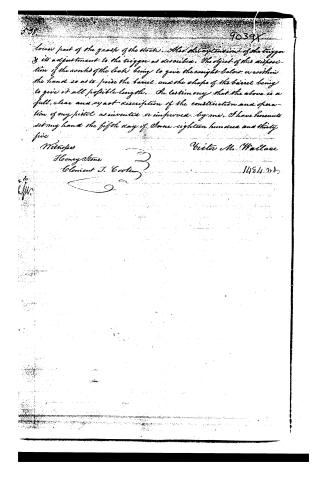
lower part of the grasp of the stock. Also the extension of the trigger & its adjustment to the trigger as described. The object of this disposition of the works of the lock being to give the weight below or within the hand so as to poise the barrel and the shape of the barrel being to give it all possible length. In testimony that the above is a full, clear and exact description of the construction and operation of my pistol as invented or improved by me, I have hereunto set my hand the fifth day of June eighteen hundred and thirty five
Witnesses
Henry Stone
Clement J. Cooley
Victor M. Wallace
1484 2nd
Published accounts: journal notice
Notice in the monthly list of patents
Journal of the Franklin Institute, new ser., vol. 16 (1835), p. 287 · View the page
475. Pocket pistol. - Victor M. Wallace, West Topham, Vt.
Published accounts: journal notice
Notice in the monthly list of patents, with remarks
Journal of the Franklin Institute, new ser., vol. 17 (1836), p. 203 · View the page
33. For a Pocket Pistol; Victor M. Wallace, West Topham, Orange county, Virginia, August 17.
Remarks. The object of this invention is "to give the greatest length possible to the barrel of the pistol, for the purpose of discharging the ball with increased velocity and greater precision in its direction, as well as to a greater distance." To effect this object the back end of the barrel is cylindrical, and is passed into the stock, reaching to its end, the part grasped by the hand descending nearly at right angles from the upper portion. The percussion cap passes on to a nipple at the centre behind the barrel, the trigger operating upon it through the intermedium of a main spring and other appendages, contained within the handle of the stock. The claim "is not to the discharge from the centre of the breech-pin, but simply to the manner of construction described, namely, the rounded back part of the barrel, with the manner in which I insert the breech pin, for the purpose of drawing the shoulders of both towards each other; also the disposition of the lock, as contained in the lower part of the grasp of the stock, also the interior of the trigger, and its adjustment as described." There is some sacrifice made by rounding the back part of the barrel, as the breech is thereby rendered smaller than the outer, or muzzle, end; perhaps, however, means may be found to remedy this defect.
About this record
- Patentee
- DATAMP
- Date
- DATAMP, USPTO records
- Invention
- DATAMP
- Listed in
- the Name and Date index of patents, DATAMP, USPTO records, Jim Shaw's X-patent list, the Journal of the Franklin Institute, Burke's List of Patents (1847)
- The sources give different dates; the date shown is the one most of them agree on.
- The Franklin Institute's journal spells the name differently.
- The Franklin Institute's journal confirms the date shown.
- Burke's 1847 Patent Office list gives the same patent.