

Drawings and documents
National Archives restored drawings: drawing
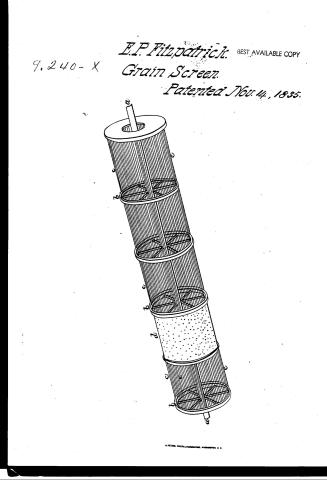
E.P. Fitzpatrick's Patent Drawing for a Revolving Screen for Cleaning Granite

National Archives, Restored Patent Drawings (Record Group 241) · Full-size scan at the National Archives · Catalog record
Show the text on the drawing Hide (71 words)
Words on the drawing as machine-read by the National Archives; not checked. Useful mainly for searching.
$1,00 / Vol 23. page 309 / 130. THRASHING. / Grain Separators. / C. Rotary Screens. / 9240X / Intented 14 Noo 1.835) / DIVISTON. / 9240X / Runbing Screen for cleaning Grainic. / a Cast Iron axis / b. Casthears 07' circles / C. Rods / d. Metal covering / Strichland Del / Patens office angtin 1842 / Patent Made in under the direction of the communicates of / conformity with act or 3' March Asui / H.Liumonth / lown to
USPTO scan
The patent as scanned by the USPTO
-
 Page 1
-
 Page 2
-
 Page 3


U.S. Patent and Trademark Office · Google Patents
Show the transcription Hide (928 words)
Machine transcription (LightOnOCR) of the pages as scanned by the USPTO, most of them the handwritten copies made when the records were restored after the 1836 fire. Not checked; it can misread handwriting, so compare it with the scan.
Page 1.
9,240-X
E.P. Fitzpatrick. BEST AVAILABLE COPY
Grain Screen.
Patented Nov. 14, 1835.
K. PETERS, PHOTO-LITHOGRAPHER, WASHINGTON, D.C.
Page 2.
9240X Nov. 14, 1835 309
Edward P. Fitzpatrick Mount Morris New York
Letters Patent.
The Specifications referred to in these Letters Patent and making part of the same containing a description in the words of the said Edward P. Fitzpatrick himself of his improvement in the manner of constructing the Cooling Screen for cleaning Grain &c.
To all to whom these presents shall come, Be it known that I Edward Fitzpatrick of Mount Morris in the County of Livingston and State of New York have invented a new and useful improvement in the manner of constructing the Cooling Screen for cleaning small grain such as Wheat Oats &c. and that the following is a full and exact description of the said manner of construction and of the operation thereof. Also showing the difference between my principle and that of the heretofore used cooling to the screen (presenting numerous small square or oblong openings for the passage of the substance to be driven off or disposed of.)
On this plan there numerous difficulties and obstructions to the free discharge which I remedy by the application of longitudinal bars or wires to the length of the cylinder as a covering for the passage of certain substances, and round holes drilled or punched leaving no bars around them for the discharge of others. in which manner an uninterrupted egress is permitted in the direction of the length of the cylinder aided by the spiral motion obtained at the circumference from the usual inclination of the axle.
In constructing my Screen I make use of an axis of cast iron which is to revolve and give motion to the surrounding cylinder by means of cast heads or circles connected by arms to this axis. These circular rims are formed with grooves in the sides for the purpose of receiving the ends of the longitudinal rods intended to form the circumference. They are screwed on to the axle in as many spaces and as often in number as may be found necessary according to the variety of openings I intend to form between the bars. The grooves should be of sufficient size to receive the ends of No 6 wire, which I find to answer well, and in the first or top division or space of place the ends of the long rods so close together in the groove as only to admit of the passage of dust or sand &c. to the other end of the rods is adapted the groove in the side of the circular rim which bounds the first space and in this situation they are secured by forcing into the grooves melted lead or other suitable metal which hardening around each rod or rod secures them in the position given them. On the
Page 3.
310. 9240X
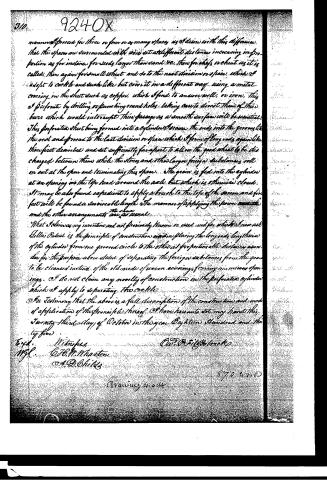
manner of spaced for three or four or as many spaces as I desire with this difference. That the spaces are surrounded with wires at different distances increasing in proportion as for instance for seeds larger than sand &c. then for chaff or chaff as it is called, then again for small wheat and so to the next division or space which I adapt to cockle and such like but cover it in a different way, using a metal covering in the sheet such as copper, which I find to answer well, or iron. This I perforate by drilling or punching round holes, taking care to direct them of their bore which would interrupt their passage as a smooth surface will be essential. This perforated sheet being formed into a cylinder because the ends into the grooves like the seat and proceed to the last division or space which I form of long rods again like those first described and set sufficiently far apart to allow the good wheat to be discharged between them while the stones and other large foreign substances roll on out at the open end terminating this space. The grain is fed into the cylinder at an opening in the top head around the axle but which is otherwise closed. It may be also found expedient to apply a brush to the top of the screen and fine feet will be found a serviceable length. The manner of applying the power and the other arrangements are as usual.
What I claim as my invention and not previously known or used and for which I now ask Letters Patent is the principle of construction and in placing the long rods lengthwise of the cylinder from one grooved circle to the other at proportionable distances according to the purpose above stated of separating the foreign substances from the grain to be cleaned instead of the old mode of iron coverings forming numerous openings. I do not claim any novelty of construction in the perforated cylinder which I apply to separating the cockle.
In Testimony that the above is a full description of the construction and mode of application of the principle thereof, I have hereunto set my hand this Twenty-third day of October in the year Eighteen Hundred and thirty-five.
Expt. Witnesses
M.P.L. C.H.M. Wharton
A.D. Childs
O.W. P. S. S. B. S. B. S. B. S. B. …
Published accounts: journal notice
Notice in the monthly list of patents
Journal of the Franklin Institute, new ser., vol. 17 (1836), p. 144 · View the page
708. Propelling by screw.-E. P. Fitzpatrick, Mount Morris, New York,
Published accounts: journal notice
Notice in the monthly list of patents, with remarks
Journal of the Franklin Institute, new ser., vol. 17 (1836), p. 406 · View the page
15. For a Revolving Screen for Cleaning Grain; Edward P. Fitzpatrick, Mount Morris, Livingston county, New York. An alien, who has resided two years in the United States; November 14.
Remarks. Instead of using woven wire, in meshes, as is usually done, this screen is to have wires running straight along it; of these there are to be several sections in the length of the screen, each section extending from one rim to another, which is fastened upon the axle for that purpose. The screen is to be inclined, and the grain fed in at the upper end, in the usual way; the wires in the first section are to be so close together as to allow only dust to pass; the next is to allow cheat to escape; the next small wheat, and the last large wheat. Between the two last it is proposed to form the cylinder of sheet metal, instead of wire, and to punch it full of smooth round holes, large enough for the discharge of cockle. The claim is to the placing of rods, or wires, lengthwise of the cylinder, from one groove circle to the other, at suitable distances apart, for cleaning grain; instead of woven coverings, with numerous openings.
About this record
- Patentee
- the Journal of the Franklin Institute, Journal
- Date
- the Name and Date index of patents, USPTO records, Jim Shaw's X-patent list
- Invention
- the Name and Date index of patents
- Listed in
- the Name and Date index of patents, USPTO records, Jim Shaw's X-patent list, the Journal of the Franklin Institute, Burke's List of Patents (1847)
- The patentee's full name comes from the Franklin Institute's journal.
- Burke's 1847 Patent Office list gives the same patent.