

Drawings and documents
National Archives restored drawings: drawing
E.P. Fitzpatrick's Patent Drawing for a Smut Machine

National Archives, Restored Patent Drawings (Record Group 241) · Full-size scan at the National Archives · Catalog record
Show the text on the drawing Hide (96 words)
Words on the drawing as machine-read by the National Archives; not checked. Useful mainly for searching.
$150 / 83. MILLS. / Grain Scourers. / Cylinder, Vertical. / Smut Machine / Patented) 14clov-1835- / of V4" / $285 / classIvication / 9241-1 / DIVISION / References / 9241 X / a. surrounding case or cylinder of Rods / b. Beaters. A. axis of vo / C. Circular bands or hoop / d. cercular Frame and benights / e. arms with circular plates E / rods or bars secured by / lead in proved raye e / Shicklands Del / Patent 1842 / Mode under the dereclian of the comminer of patent in / comformity with heta 3 March 1837 / M Leunoon the / Communision of Patents
USPTO scan
The patent as scanned by the USPTO
-
 Page 1
-
 Page 2
-
 Page 3
-
 Page 4


U.S. Patent and Trademark Office · Google Patents
Show the transcription Hide (992 words)
Machine transcription (LightOnOCR) of the pages as scanned by the USPTO, most of them the handwritten copies made when the records were restored after the 1836 fire. Not checked; it can misread handwriting, so compare it with the scan.
Page 1.
E. P. FITZPATRICK.
9241X
SMUT MILL.
Patented Nov. 14, 1835.

THE NORMAN PETERS CO., PHOTO-LITHO., WASHINGTON, D. C.
Page 2.
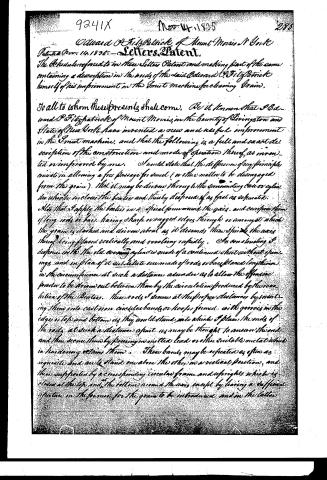
Edward O. FitzPatrick of Mount Morris N York
Patented Nov. 14, 1835. — Letters Patent.
The Schedule referred to in these Letters Patent and making part of this one containing a description in the words of the said Edward O. FitzPatrick himself of his improvement in the Grind machine for cleaning Grain.
To all to whom these presents shall come. Be it known that I Edward O. FitzPatrick of Mount Morris in the County of Livingston and State of New York have invented a new and useful improvement in the Grind machine, and that the following is a full and exact description of the construction and mode of operation thereof, as invented or improved by me. I would state that the difference of any principle consists in allowing a free passage for small (or other matter to be disengaged from the grain) that it may be driven through the surrounding case or cylinder which encloses the beater and thereby disposes of as fast as separated. Also that I apply the beater in a spiral form around the axis, and compose them of long rods or bars having sharp serrated edges through or amongst which the grain is dashed and driven about as it descends therefrom the axis thereof being placed vertically and revolving rapidly. In constructing I dispense with the old covering cylinder made of a continuous sheet without openings and in place of it substitute one made of rods or bars placed lengthwise in the circumference at such a distance asunder as to allow the offensive powder to be drawn out between them by the circulation produced by the revolution of the Beater. These rods I secure at the proper distances by inserting them into cast iron circular bands or hoops formed with grooves in the edges at top and bottom as they would stand into which I place the ends of the rods at such a distance apart as may be thought to answer the end and then secure them by pouring in molten lead or other suitable metal which in hardening retains them. These bands may be repeated as often as requisite and one to stand one above the other in a vertical position, and then supported by a corresponding circular frame and uprights which is closed at the top and the bottom around the axis except by leaving a sufficient aperture in the frame for the grain to be introduced and in the latter
Page 3.
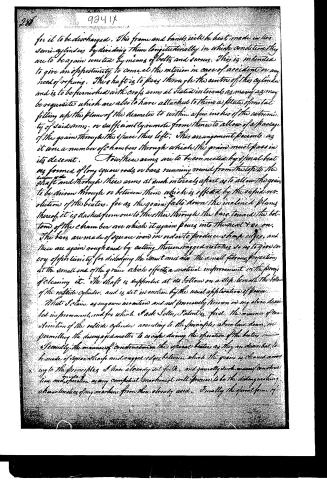
for it to be discharged. This frame and bands will be best made in two semi-cylinders by dividing them longitudinally in which condition they are to be again united by means of bolts and screws. This is intended to give an opportunity to come at the interior in case of accident or any need of repairing. The shaft is to pass through the centre of this cylinder and is to be furnished with cross arms at stated intervals as many as may be requisite which are also to have attached to them a plate of metal filling up the plane of the diameter to within a few inches of the extremity of said arms, or sufficiently remote from them to allow of a passage of the grain through the space thus left. This arrangement presents as it were a number of chambers through which the grain must pass in its descent. To these arms are to be connected by spiral beaters formed of long square rods or bars running round from the top of the shaft and through these arms at such intervals apart as to allow the grain to be driven through or between them which is effected by the rapid revolutions of the beaters, for as the grain falls down the inclined planes thereof, it is dashed from one to the other through the bars towards the bottom of the chamber over which it again pours into the next and so on. The bars are made of square iron in order to produce sharp edges, and these are again roughened by cutting through ragged notches so as to give every opportunity for dislodging the dust and also the small fibrous imperfections at the small end of the grain which effects a material improvement in the process of cleaning it. The shaft is supported at its bottom on a step beneath the bottom of the outside cylinder, and is set in motion by the usual application of force.
What I claim as my own invention and not previously known in my above described improvement, and for which I ask Letters Patent is, first, the manner of construction of the outside cylinder according to the principles above laid down, in permitting the disengaged matter to escape during the operation of the beaters. Secondly, the manner of construction of the spiral beaters as they are described, to be made of square shafts and ragged edges, between which the grain is cleaned according to the principles I have already set forth, and generally such manner of construction and operation as any competent mechanist will perceive to be the distinguishing characteristics of my machine from those already used. Finally, the spiral form of
Page 4.
92411X
I do hereby claim for this purpose (as different from those heretofore used) for the reasons shown. In testimony that the above is a full description of the construction and mode of operation of my improvement, as invented by me, I have hereunto set my hand this twenty-third day of October in the year eighteen hundred and thirty.
Witnesses:
C. R. N. Wharton
H. D. Childs
O. W. Fitzpatrick
966 words.
$\frac{21}{132}$
$\frac{2}{432}$
Grainville, Md. 38
287
Loyd
1196
Published accounts: journal notice
Notice in the monthly list of patents
Journal of the Franklin Institute, new ser., vol. 17 (1836), p. 144 · View the page
702. Smut machine.-E. P. Fitzpatrick, Mount Morris, New York,
Published accounts: journal notice
Notice in the monthly list of patents, with remarks
Journal of the Franklin Institute, new ser., vol. 17 (1836), p. 407 · View the page
21. For an improvement in the Smut Machine; Edward B. Fitzpatrick, Mount Morris, Livingston county, New York, November 14.
Remarks. This smut machine is to consist of an outer stationary cylinder, standing vertically, its periphery being formed of longitudinal rods or wires, placed so close together that grain will not pass between them, whilst the dust from the smut will escape readily. Within this there are to be revolving beaters formed by extending square iron rods from one set of cross arms on the lower end of a revolving shaft, within the cylinder, to other similar cross bars near the upper end of the shaft, and close within the heads of the cylinder; these rods are to be made ragged at their edges, and placed near together on the cross arms, extending from the shaft to the periphery of the cylinder. They are not to run directly along with the cylinder, but spirally, just as they would stand supposing them to be put in straight at first, and one of the sets of cross arms to be then turned half way round, thus giving a spiral direction to the rods. The grain is to be fed in through the upper head of the cylinder, and to escape through an opening in the bottom head; but in passing down it is driven forcibly about by encountering the spiral beaters, the shaft of which revolves with great rapidity, and by this means, it is said, the smut is effectually removed. The claim is to the above described manner of constructing a smut machine.
About this record
- Patentee
- Jim Shaw's X-patent list
- Date
- the Name and Date index of patents, USPTO records, Jim Shaw's X-patent list
- Invention
- the Name and Date index of patents
- Listed in
- the Name and Date index of patents, USPTO records, Jim Shaw's X-patent list, the Journal of the Franklin Institute, Burke's List of Patents (1847)
- Burke's 1847 Patent Office list gives the same patent.