

Drawings and documents
National Archives restored drawings: drawing
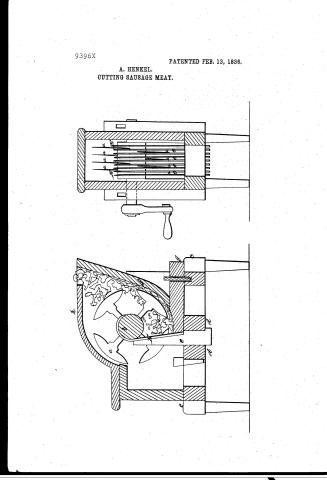
A. Henkel's Patent Drawing for a Machine for Cutting Sausage Meat

National Archives, Restored Patent Drawings (Record Group 241) · Full-size scan at the National Archives · Catalog record
Show the text on the drawing Hide (92 words)
Words on the drawing as machine-read by the National Archives; not checked. Useful mainly for searching.
+2 - / lof lo / Uol. 25 page 277 / 17. BUTCHERING. / Patenles) 13th Feb. 1836 / [25] Grinding & Mincing. / AHENKEL / 9.396.X / DIVISION. / Cutting sausage meat / 9396 X / Streetland Dei / a. curved Knives / b. Wooden cylander / Tatent office gune 1843 / C. Frame / d. crosppiences in middle of France / Made under the direction of the commission of / forming a comb / e. unnight bass with Iron plate E / Patents in couformity with ach of march 1037 / f Movable concave bed / ge Bottom board / h. Cap / useamosth / Communitions of Patents
USPTO scan
The patent as scanned by the USPTO
-
 Page 1
-
 Page 2
-
 Page 3
-
 Page 4


U.S. Patent and Trademark Office · Google Patents
Show the transcription Hide (1,366 words)
Machine transcription (LightOnOCR) of the pages as scanned by the USPTO, most of them the handwritten copies made when the records were restored after the 1836 fire. Not checked; it can misread handwriting, so compare it with the scan.
Page 1.
9396X
PATENTED FEB. 13, 1886.
A. HENKEL.
CUTTING SAUSAGE MEAT.

Page 2.
Feb. 13, 1836
Ambrose Henkel, of New Market, Va.
Letters Patent
The schedule referred to in these Letters Patent, and making part of the same, containing a description in the words of the said Ambrose Henkel himself of his improvement in the machine for cutting sausage meat and other substances.
To all to whom these presents shall come: Be it known that I, Ambrose Henkel of the town of New Market, in the County of Shenandoah, and State of Virginia, have invented a new and useful sausage cutting machine, which may also be used for cutting many other substances, and that the following is a full and exact description thereof. First, this machine consists of eight strong curved knives with the cutting edge on the convex edge, six inches long, and one and a half inch wide, placed in a spiral manner, at equal distances around a solid wooden cylinder, which is six inches long and three and a half inches in diameter. The shanks of the knives passing through the cylinder, and secured by a screw tap, counter sunk flush with the surface of the cylinder. Secondly, of a box, eighteen inches long and six inches wide in area, nine inches high, one end left open, without a bottom. In the middle of this box there are two upright pieces, nailed on the outside, fourteen inches long, four inches wide and one and half inch thick, with a cleft from the top down, two inches in width, to receive the guides of the cylinder, which are confined down with two keys placed in the side pieces. This box is confined to a frame, made of scantling two by three inches thick, the area of which is the same size as that of the said box. It is necessary for the side pieces of the frame to extend out from the frame far enough to receive legs. There are also two cross pieces in the middle of this frame of the same size timber as that of the frame, the one placed stationary immediately under the cylinder, the other movable, with two wedges before it. Between these two cross pieces are confined nine wooden upright bars, which extend six inches above the top of the frame. These bars are two inches wide at bottom, tapering to one inch at top, the front edge is one half inch thick, tapering back nearly to a sharp edge. There is a vacancy between the upright bars, sufficient to admit the passage of the knives. These upright bars also extend below the cross pieces of
Page 3.
the frame far enough to admit a notch being cut in one edge, to fit the stationary cross piece. It is necessary that these upright bars be plated in the front with strong strap iron, extending two inches higher than the bars, bending round the cylinder and tapering to a point, in order to guide the knives. When the moveable cross piece is wedged upright against the upright bars, they then stand firm in a perpendicular manner, forming a comb, when the cylinder is turned the knives alternately pass through the spaces. The plated edges of the upright bars right range with the front side of the guides of the cylinder.
Thirdly, of a moveable concave bed, which is placed in the open end of the box, fitting close up to the circle of the knives, in order to confine the meat in reach of the knives. This concave bed consists of a concave board as high as the box, with two sideboards of the same height each fitting at one end close up to the upright bars and cylinder, and are as thick as the space is between the outside knives and the box, so that when the cylinder is turned the outside knives will touch slightly in the inner sides of these side boards. The upper edges of these side boards are bevelled off to an edge, so that the meat may not lodge on them. There is also a bottom board, which is bevelled off to an edge at the end next to the upright bars, forming a part of the circle of the concave. This board extends back over the end rail of the frame, with an inch hole through it, and corresponding one through the said end rail, in which a loose pin is placed, in order to confine the concave bed to its proper place. Fourthly, of a cap, which is placed on the box, in order to confine the meat of the same length and width of the box, three inches high, with an inclined end board, corresponding with the concave board in the concave bed. A hole is left in the cap, large enough to receive the meat. In making this machine, the dimensions thereof may be varied in many ways, according to pleasure, viz. It may be geared, so that the cylinder may have more velocity, a balance wheel may be added. The cylinder may be made shorter or longer, more or less in diameter, and instead of wood it may be made of metal. The number of knives may be increased or decreased; they may be made longer or shorter, broader or narrower, more curved or straighter. Instead of being only bevelled on one side, they may be bevelled on both sides. They may be set wider apart, or close together, and instead of their being plated singly in a spiral manner round the cylinder, they may be placed in
Page 4.
9396X 277
such a manner that two or more may pass through the upright bars at the same time. The upright bars may be broader or narrower; they may evenly be made like knives; they may be made entirely of metal, they may be made to extend up to the cap, they may be curved backwards, or forwards, they may be set horizontally or obliquely, farther forwards or farther under the cylinder. — — —
The concave bed may be perforated with half inch holes, when this is the case, the bottom board is then left away and in its stead only a cross piece is dovetailed in the ends of the side boards of the concave, through or before which the loose pin in the end rail of the frame can be placed. The concave may also have a lateral motion by a fixture on the outside, similar to the shaker of a wheat fan or in any other way that may seem best. The concave board in the concave bed may be left one inch shorter at the lower end which will then form a groove at the bottom of the upright bars, into which the bones, that accidentally may have been left in the meat, will lodge, so that they may not hinder the progress of cutting. N.B. So arrange the knives in the cylinder, so that they cut by pairs to perforate the concave, and to leave a groove for the bones, as above described, appears, from late trials, to be the most approved plan; Note. —
What I claim as my own invention and not previously known in the above described machine, is a cylinder with knives, secondly their cutting between bars of any kind, and thirdly, the general construction of the machine. — —
Directions for using this machine — The meat is thrown in gradually, and kept tolerably full, a little hot gravy or water is occasionally added if considered necessary. It is necessary to place a vessel under the machine to receive the meat. The meat that does not pass through the holes, or is not drawn through by the knives can easily when fine enough, be emptied by drawing out the concave bed. When the knives become dull they can easily be taken out of the cylinder and sharpened
Witnesses
Solomon Henkel
Lewis H. Wolfe
Andrew Henkel
1965 m.d.
Drawing made
Exh. 1156
Published accounts: journal notice
Notice in the monthly list of patents, with remarks
Journal of the Franklin Institute, new ser., vol. 18 (1836), p. 194 · View the page
57. For a Machine for Cutting Sausage Meat; Ambrose Henkel, Shenandoah county, Virginia, February 13.
Remarks. The general construction of this machine may be inferred from the claim to "a cylinder with knives; secondly, their cutting between bars of any kind; and thirdly, the general construction of the machine." This claim is much too broad, the two first items in it not being sustained by their novelty, and not, therefore, sustaining the third.
About this record
- Patentee
- DATAMP
- Date
- the Name and Date index of patents, DATAMP, USPTO records
- Invention
- DATAMP
- Listed in
- the Name and Date index of patents, DATAMP, USPTO records, Jim Shaw's X-patent list, the Journal of the Franklin Institute, Burke's List of Patents (1847)
- Burke's 1847 Patent Office list gives the same patent.