

Drawings and documents
USPTO scan
The patent as scanned by the USPTO
-
 Page 1
-
 Page 2
-
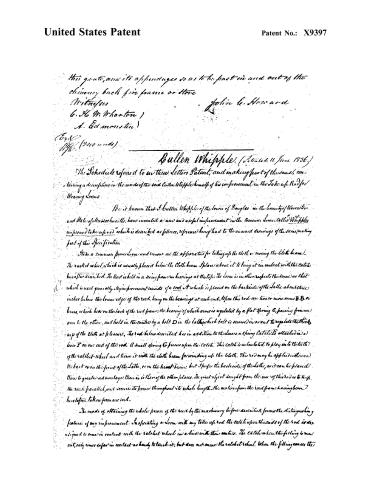 Page 3


U.S. Patent and Trademark Office · Google Patents
Show the transcription Hide (882 words)
Machine transcription (LightOnOCR) of the pages as scanned by the USPTO, most of them the handwritten copies made when the records were restored after the 1836 fire. Not checked; it can misread handwriting, so compare it with the scan.
Page 2.
United States Patent
Patent No.: X9397
I do not claim as my invention the furnace or grate, but I claim as my invention the improvement in the grate by which it is suspended on guard-irons and made to move by a handle as before described.
In testimony that the foregoing is a true description and specification of my said invention I have hereunto set my hand this twenty-eighth day of August in the year of our Lord eighteen hundred and thirty-five.
Witnesses
G. E. Small
Samuel Sprouden
Nathan Winslow
(2406) John L. Howard
Letters Patent (Patented February 13, 1836)
The Schedule referred to in these Letters Patent and making part of the same, containing a description in the words of the said John L. Howard himself of his Improvement in the sliding grate for fireplaces, stoves &c.
To all to whom these Presents shall come. Be it known that I John L. Howard of Howard’s Valley in the County of Windham & State of Connecticut have invented a new and useful improvement in the cast iron grate—and that the following is a full and exact description thereof. A grate passing in front of the back of the chimney by means of a curved iron back—assisted with cast rollers running on a track. The back of the grate raised to forty-five degrees from frame of grate to form a brace to support the iron which in use. On the top of the sides of grate is locked passing in a groove to a lock & when together holds the grate in a horizontal manner for use. The side of grate suited to fire places, fire frame or stoves to which it may all be applied. What I claim as my own invention & not previously known in the above described article is the manner of constructing
Page 3.
United States Patent
Patent No.: X9397
This grate, and its appendages so as to be fast in and out of the chimney back fire frame or stove
Witnesses
G. H. M. Wharton
A. Edmonstone
By:
J. C. (2110 words)
Bullen Whipple. (Patented 11 June 1836.)
The Schedule referred to in these Letters Patent, and making part of this same, containing a description in the words of the said Bullen Whipple himself of his improvement in the Take up Rod for Weaving Looms.
It is known that J. Bullen Whipple of the town of Douglas in the County of Worcester and State of Massachusetts, have invented a new and useful improvement in the common Loom, called Whipple improved take up rod which is described as follows, reference being had to the annexed drawings of the same, making part of this Specification.
Take a common power Loom and remove out the apparatus for taking up the cloth or moving the cloth beam. The ratchet wheel, which is usually placed below the cloth beam. Place above it to bring it in contact with the catch hereafter described. The Reed is held in a swing frame on bearings at the top. The Loom is in other respects the same as that which is used generally. My improvement consists of a rod A which is placed on the backside of the Lath about three inches below the lower edge of the reed, hung on the bearings at each end. Upon this rod are two or more arms B B or levers, which bear on the back of the reed frame; the bearing of which arms is regulated by a flat Spring C, passing from one arm to the other, and held in the centre by a bolt D in the Lath, which bolt is screwed in or out to regulate the thickness of the cloth at pleasure. The rod below described has in addition to the levers a spring catch E attached in a lever F on one end of the rod. A small spring G presses upon the catch. This catch is calculated to play in to the teeth of the ratchet wheel and turn it with the cloth beam for winding up the cloth. This rod may be applied either on the back or on the front of the Lath, or on the breast beam; but I prefer the backside of the Lath, as it can be placed there to greater advantage than in either of the other places. The great object sought from the use of this rod is to keep the reed parallel, and secure its power throughout its whole length—the motion from the reed frame having been heretofore taken from one end.
The mode of obtaining the whole power of the reed by the machinery before described forms the distinguishing feature of my improvement. In operating a Loom with my take up rod the catch upon the end of the rod is designed to come in contact with the ratchet wheel in a line with their axes. The catch when the filling is run out, only comes so far in contact as barely to touch it, but does not move the ratchet wheel. When the filling comes the
Published accounts: journal notice
Notice in the monthly list of patents, with remarks
Journal of the Franklin Institute, new ser., vol. 18 (1836), p. 193 · View the page
53. For a Sliding Coal Grate; John C. Howard, Howard's Valley, Windham county, Connecticut, February 13.
Remarks. A cast-iron grate, upon which a fire may be made, is to run in and out upon ways, on the sides of a fire place. The description of the thing is very imperfect, but a claim is made to "the manner of constructing this grate and its appendages, so as to be passed in and out of the chimney back, fire frame, or stove." Sliding, or "rail way grates," are no novelties, there, however, may some unperceived advantages in the plan intended to be described. be VOL. XVIII.-No. 3.-SEPTEMBER, 1836.
About this record
- Patentee
- DATAMP
- Date
- the Name and Date index of patents, DATAMP, USPTO records
- Invention
- DATAMP
- Listed in
- the Name and Date index of patents, DATAMP, USPTO records, Jim Shaw's X-patent list, the Journal of the Franklin Institute, Burke's List of Patents (1847)
- Burke's 1847 Patent Office list gives the same patent.